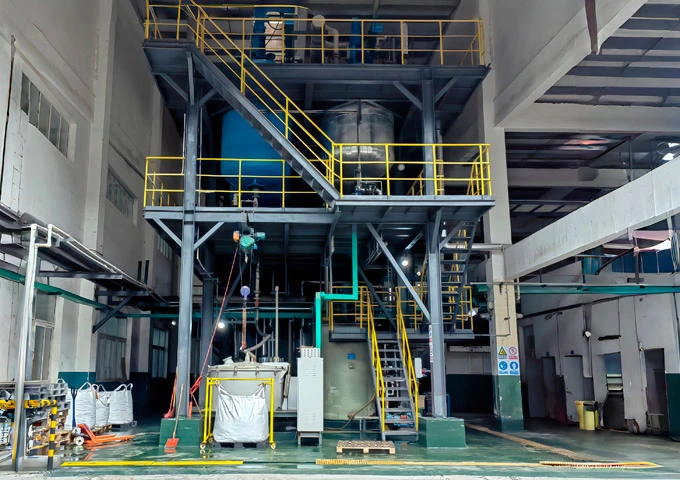
When engineers face a liquid stream that clogs standard evaporators within hours—maybe it is loaded with suspended solids, prone to scaling, or so viscous it barely moves—they almost always end up looking at the same piece of equipment: a circulation evaporator. It is not the newest technology on the block, and it does not win awards for being the most energy-efficient on paper. What it does win on, year after year, is reliability. When the feed is unforgiving and downtime is not an option, this is the system people trust.
But what exactly makes a circulation evaporator so robust? How do you decide between natural and forced circulation, and where does the technology stand today with MVR and zero liquid discharge driving so many purchasing decisions? That is what this article is about.
To understand why circulation evaporators are so versatile, it helps to first look at the fundamental mechanism that sets them apart from other designs. In a conventional evaporator—think falling film or rising film—boiling happens right on the heat transfer surface. That is fine for clean, low-viscosity fluids, but it becomes a problem the moment you introduce something that can scale, foul, or crystallize. Boiling on the tube wall creates hot spots, and hot spots are exactly where scale loves to form.
A circulation evaporator sidesteps this problem entirely. Instead of boiling the liquid inside the heat exchanger tubes, it circulates the process fluid at high velocity through the heating section while applying enough hydrostatic pressure to suppress boiling. The actual evaporation—the flash separation of vapor from liquid—takes place downstream, in a separate separation vessel where the pressure drops. This simple mechanical separation of "heating" and "boiling" changes everything.
Natural circulation evaporators rely on the density difference created by heating to drive flow. As the liquid warms up and partial vaporization begins, the resulting two-phase mixture becomes less dense and rises naturally through the tubes—no pump required. It is an elegant, low-maintenance design. The catch? It only works well with relatively thin, clean fluids that do not foul easily.
Forced circulation evaporators (FCEs) take the same principle and add a circulation pump. This pump pushes the liquid through the heat exchanger at a controlled, high velocity—typically fast enough to maintain turbulent flow. The turbulence does two things: it dramatically improves heat transfer, and it continuously scrubs the tube walls, keeping solids suspended and preventing fouling from getting a foothold.
That pump adds cost and energy consumption, no question. But for fluids that are viscous, scaling-prone, or loaded with suspended solids, the alternative—constant shutdowns for cleaning—costs far more.
No single evaporator type is right for every application. Falling film units excel with heat-sensitive, low-viscosity products. Rising film designs are simpler and cheaper for straightforward concentration tasks. But circulation evaporators dominate where the feed stream is genuinely difficult. Here are some of the most common scenarios.
In food processing, evaporation is everywhere—concentrating fruit juices, reducing dairy products, thickening syrups and sauces. Early in the process, when the product is still thin, a falling film evaporator often does the job efficiently. But as concentration increases, viscosity rises sharply. A product that started as a watery juice eventually behaves more like a paste.
This is where forced circulation evaporators shine. The high-velocity flow keeps even thick, pulpy materials moving, and because boiling does not occur on the heat transfer surface, there is far less risk of scorching or burning product onto the tubes. For products like tomato paste, fruit purees, jellies, and concentrated dairy streams, circulation evaporators are often the only practical choice for the final concentration stages.
For chemical manufacturers and pharmaceutical companies, evaporation is often the first step in recovering valuable salts or intermediates from solution. Here, the challenge is not just removing water—it is doing so in a way that promotes controlled crystal growth without encrusting the equipment.
Forced circulation evaporators can operate as crystallizers, where crystals grow inside the separator vessel rather than on the heat exchanger tubes. Special separator designs handle the recirculated crystal slurry, and because the circulation pump keeps everything in motion, the system can maintain consistent crystal size distribution over long production runs. Applications include ammonium sulfate recovery, sodium chloride crystallization, and concentration of pharmaceutical intermediates.
Zero Liquid Discharge (ZLD) has gone from a niche regulatory requirement to a mainstream industrial goal, driven by tightening discharge permits and growing interest in water reuse. ZLD means exactly what it sounds like: no liquid waste leaves the plant. Instead, all wastewater is reduced to clean condensate (which can be reused) and a solid residue (which can be disposed of or, ideally, recovered as a product).
This is a punishing application for evaporation equipment. ZLD feed streams often contain high concentrations of salts, scaling ions, and corrosive compounds. As water is removed, the remaining brine becomes increasingly concentrated—and increasingly difficult to handle. Forced circulation evaporators are widely used in ZLD systems precisely because they can handle these extreme conditions, particularly in the final concentration and crystallization stages.
The lithium battery recycling industry, for example, depends heavily on forced circulation evaporation for recovering lithium, nickel, cobalt, and manganese from process streams. The feed chemistry is complex and variable, making robust, fouling-resistant equipment essential for economic operation.
Fouling is the silent killer of evaporator performance. Even a thin layer of scale on heat exchanger tubes can cut heat transfer efficiency dramatically, pushing up energy costs and forcing unscheduled downtime for cleaning. In severe cases, tube blockage can damage equipment and halt production entirely.
The cost of fouling extends well beyond the energy penalty. Chemical cleaning agents, lost production time, and shortened equipment life all add up. Some plants budget for multiple cleaning cycles per year on standard evaporators—a cost that can rival the equipment's energy bill over its lifetime.
Circulation evaporators, and forced circulation designs in particular, mitigate fouling through several mechanisms working together. First, by separating the heating zone from the boiling zone, they avoid the hot-spot conditions that trigger scale nucleation. Second, the high-velocity turbulent flow through the tubes continuously scrubs the surfaces, physically preventing solids from settling. Third, because evaporation occurs in the separator rather than the heat exchanger, any crystals that do form remain suspended in the circulating slurry rather than adhering to tube walls.
For processes where even forced circulation is not enough, hybrid configurations offer another layer of protection. A common approach is to use a falling film evaporator for the early, low-concentration stages where the feed is still relatively clean, and then switch to a forced circulation evaporator for the final concentration step where viscosity and fouling potential peak.
Energy is the single largest operating cost for any industrial evaporation system, and circulation evaporators are no exception. Over the past decade, energy recovery technologies—specifically Mechanical Vapor Recompression (MVR) and Thermal Vapor Recompression (TVR)—have transformed the economics of evaporation, and both can be paired with circulation evaporator designs.
MVR is fundamentally a heat pump. The secondary vapor produced during evaporation is captured and compressed by a mechanical compressor, which raises its pressure and temperature. The compressed vapor is then fed back into the heat exchanger as the heating medium, replacing the need for fresh steam almost entirely. The coefficient of performance (COP) for MVR systems typically reaches 10–20, meaning that for every unit of electrical energy input, the system delivers 10 to 20 units of thermal energy.
TVR achieves a similar goal using a different mechanism. Instead of a mechanical compressor, TVR uses a steam ejector—a device with no moving parts—to entrain and compress part of the secondary vapor using high-pressure motive steam. The result is a partial recovery of the vapor's latent heat, effectively adding about one extra "effect" worth of energy efficiency without the complexity of a compressor.
The choice between MVR and TVR for a circulation evaporator system is not simply about which is more efficient on paper. It hinges on the realities of your site.
Choose MVR when you have access to reliable, reasonably priced electricity and want to minimize or eliminate steam consumption. MVR is ideal for regions with high steam costs or where carbon footprint reduction is a priority—an increasingly common scenario as carbon border adjustment mechanisms take effect globally.
Choose TVR when you already have excess steam capacity or when capital expenditure (CAPEX) is the primary constraint. TVR systems have lower upfront costs because they do not require expensive compressors, and their simple, no-moving-parts design means minimal maintenance. However, they still consume live steam continuously, so long-term operating costs tend to be higher.
According to industry data, when configured for forced circulation, MVR systems can reduce steam demand by 70–90% compared to conventional single-effect evaporation, making them the preferred choice for many ZLD and high-volume industrial applications.
Choosing equipment is only half the decision. Choosing a supplier who can design, deliver, and support the system over its entire operating life is the other half. Here are the factors that experienced plant engineers tend to prioritize.
1. Application-specific engineering capability. A circulation evaporator is not a commodity product. The design needs to account for the specific chemistry, viscosity, scaling tendency, and corrosiveness of your feed stream. Suppliers who ask detailed questions about your process conditions before proposing a solution tend to deliver better long-term outcomes than those who lead with a standard specification sheet. From material selection (316L, duplex stainless, or higher alloys) to tube geometry and circulation pump sizing, each choice has consequences for reliability and maintenance intervals.
2. Pilot testing and process validation. For complex or unfamiliar feed streams, pilot-scale testing is invaluable. It allows engineers to characterize boiling point rise (BPR), observe scaling behavior, and generate the data needed for accurate full-scale design. Companies that offer pilot testing capabilities—or modular, scalable systems that allow for phased capacity expansion—reduce the risk of costly design errors at the commercial scale.
3. Integrated energy recovery expertise. Given that energy consumption dominates operating costs, your supplier should have deep experience with MVR, TVR, and multi-effect configurations specifically for circulation evaporator applications. The energy recovery strategy should be designed as an integrated part of the system, not an afterthought, with full consideration of your site's available utilities and future energy price scenarios.
4. Lifecycle support and service. Evaporator systems operate for decades, and a supplier who disappears after commissioning leaves you with an accumulating risk. Look for suppliers with established service networks, spare parts availability, and a track record of supporting installed systems through troubleshooting, optimization, and retrofits over time. Ask about their remote monitoring capabilities and their typical response time for on-site support.
The circulation evaporator will never be the flashiest piece of equipment on a process flow diagram. It will never match the raw thermal efficiency of a falling film unit on clean duty, or the compact footprint of a plate evaporator. But for the streams that other technologies cannot handle—the viscous, the scaling, the solids-laden, the chemically aggressive—it remains the most dependable solution available.
When you pair a well-designed forced circulation evaporator with modern MVR energy recovery and smart process control, you get a system that combines the robust, fouling-resistant operation that circulation technology is known for with the energy efficiency that modern industry demands. Whether you are concentrating food products, recovering chemicals, or moving toward zero liquid discharge, this combination is worth a close look.
1. What is the main difference between a natural circulation evaporator and a forced circulation evaporator?
Natural circulation evaporators rely on density differences from heating to drive flow, with no mechanical pump. Forced circulation evaporators use a circulation pump to control flow velocity, making them suitable for viscous, fouling-prone, or solids-laden fluids that natural circulation cannot handle reliably.
2. When should I choose a circulation evaporator over a falling film evaporator?
Choose a circulation evaporator when your feed has high viscosity, contains suspended solids, or is prone to scaling and fouling. Falling film evaporators work well for clean, low-viscosity, heat-sensitive liquids but struggle with these challenging conditions.
3. Can a forced circulation evaporator be used for crystallization?
Yes. Forced circulation evaporators are widely used as crystallizers, with crystal growth occurring in the separator vessel rather than on the heat exchanger tubes. The high-velocity circulation keeps crystals suspended and promotes consistent crystal size distribution.
4. What is the typical energy consumption difference between MVR and TVR systems?
MVR systems consume electricity (typically 15–35 kWh per ton of water evaporated) with virtually no live steam, while TVR systems reduce but do not eliminate steam consumption. MVR offers lower long-term operating costs when electricity prices are favorable but requires higher initial investment.
5. How does a circulation evaporator prevent fouling and scaling?
It prevents fouling by separating the heating zone from the boiling zone, avoiding hot-spot conditions that trigger scale formation, and by maintaining high-velocity turbulent flow through the tubes that continuously scrubs surfaces and keeps solids suspended.


 EN
EN
 jp
jp  ko
ko  fr
fr  de
de  es
es  it
it  ru
ru  pt
pt  ar
ar